
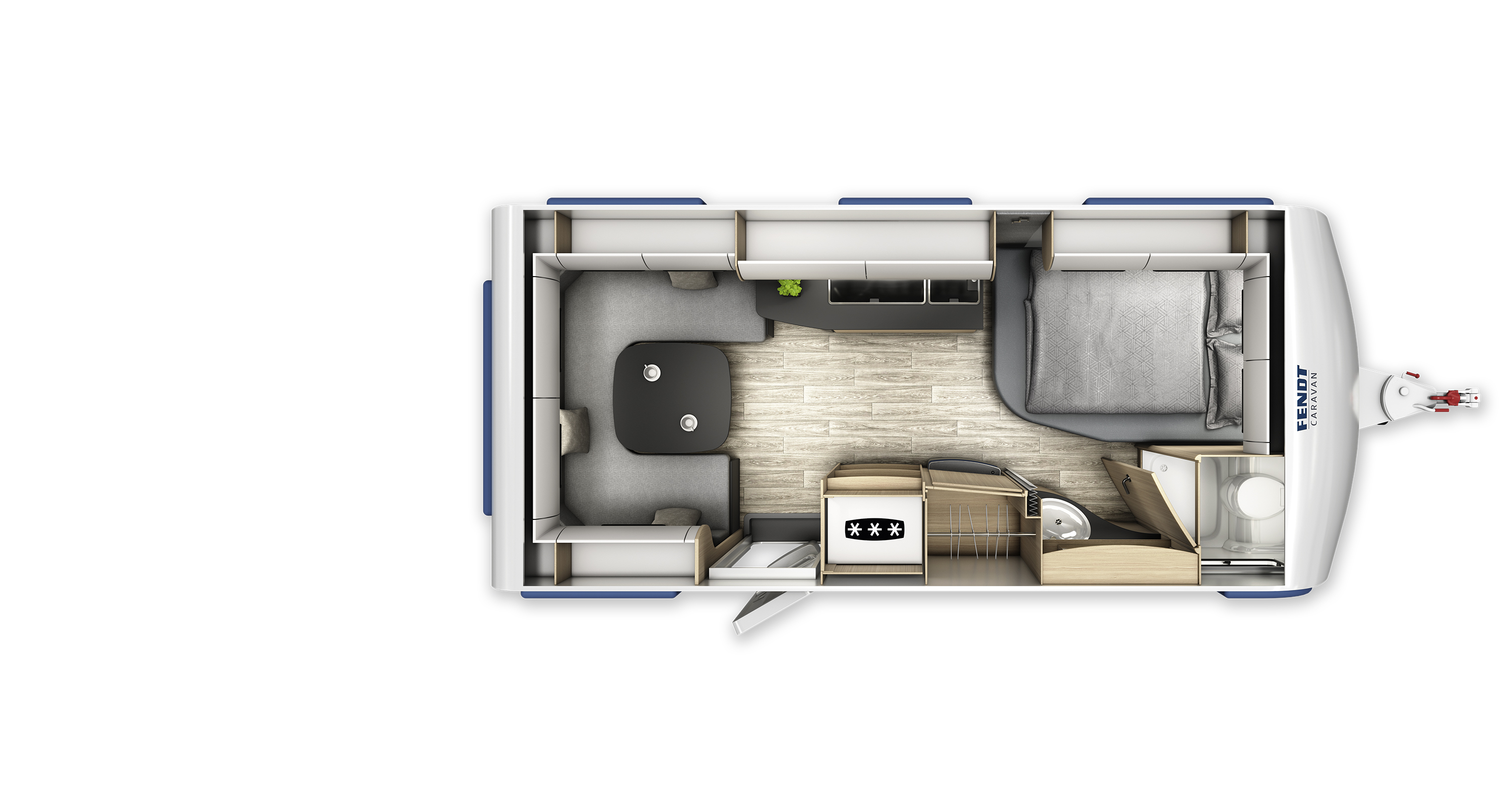
Fendt-Caravan APERO
APERO 495 SFB
- 4 Beds
- 722 cm Overall length
- 232 cm Overall width
- 266 cm max. height
Equipment
Standard equipment
Running Gear/Chassis
- Overrun device cover „weiß“
- AAA brake, self-adjusting (Al-Ko)
- Drawbar cover „weiß“
- Euro axle system (Al-Ko)
- Low-profile tyres
- Automatic reversing system
- AKS 3004 safety coupling (Al-Ko)
- Galvanised stabiliser support jacks
- Shock absorbers
- Jockey wheel with load indicator
- Lightweight system chassis, fully galvanised (Al-Ko)
- Extended crank support jacks
- Approval for Tempo 100
Body
- External storage flap
- Double-glazed, tinted awning windows with single-hand operation and combined fly screen/blackout blind
- Brake lights integrated into upper position lights
- Entrance door with integrated and insulated step, waste collector and shelf, tinted window and blackout pleated blind in the upper entrance door area
- Gas bottle compartment lid with gas strut, three-point locking
- LFI technology partially in the front
- Rear fog light(s)
- Wheel arches, fully insulated
- Manoeuvring handles, ergonomic and sturdy at front and rear
- Reversing lights (2 units)
- Sandwich construction
- Awning light (LED), dual-switched
- Water tank filler cap with retaining strap
- Central locking system
- Forced ventilation acc. to EN-Norm 1645-1
Living Area/Sleeping Area
- LED lighting
- Ceiling light (LED/12 V) with 1 circuit
- Single lift table with H-base in the seating group
- Folding sliding door
- Coat rack in the sleeping area
- Indirect lighting (LED)
- Slatted frames with fully flexible and permanently elastic joint bridges as well as firmness adjustment (single and French beds)
- Reading spotlight(s) (12 V) in the sleeping area, dimmable
- Reading spotlights (12 V) in the round seating group
- Liftomat (single and French beds)
- Mattresses: pocket spring (single and French beds)
- MIDI roof hood (Dometic) with crank, forced ventilation, integrated blackout pleated blind and fly screen blind
- Furniture in „Olmo Amico-Dekor“, upholstery variant „Brixen“ or „Parma“
- Snap-in blind with fly screen and blackout with soft-close mechanism
- Ergonomically shaped backrest cushions
- Seat cushions with high density
- Storage boxes ventilated and with indirect ceiling lighting (LED)
- Carpet at the door step with Fendt-Caravan lettering
- Vinyl flooring, hard-wearing, easy-care
- Winter backrests
Kitchen/Bathroom
- Waste collector integrated into entrance door
- Worktop lighting (LED)
- Bathroom lighting (LED/12 V)
- Cutlery inserts with soft-touch surface
- Towel rail/coat hook and toilet paper holder
- Cooker (3-burner) with flame failure device, automatic ignition, matt enamelled cooker grate, glass cover and separate sink with glass cover
- Kitchen window comfort pleated blinds
- Kitchen drawers with self-closing mechanism
- Refrigerator (133 l, with freezer compartment removed), Slim-Tower, absorber, opens from both sides, with interior lighting
- Mixer tap made of plastic
- Stainless steel sink with glass cover
- Flush toilet with diode level indicator and waste tank (rollable)
- Kitchen storage boxes with soft-close hinges
- Washbasin in white with shelves, bathroom cabinet and illuminated mirror
- Washroom window, opening, made of frosted glass with blackout and fly screen blind
Water
- Mobile waste water tank (24 l)
- Fresh water (fixed tank 10 d)/25 e) litres) with external filling
- Fresh water level indicator
- Hot water preparation Truma-Therme 230 V with mixer tap
Technology/Heating/Climate
- Double USB-C socket(s)
- Gas heater (Truma) S 3004 with automatic ignition
- Smoke detector
- Switch at the entrance door for ceiling light and awning light
- Switched-mode power supply 350 W
- Fuse box (230 V) with RCD (residual current device)
- Warm air system with blower (1 x 12 V)
Multimedia
- TV cable installation (230 V socket)
Technology
Technical details
| Overall length | 722 cm |
|---|---|
| Body length | 607 cm |
| Usable length | 526 cm |
| Overall width | 232 cm |
| max. height | 266 cm |
| Standing height | 198 cm |
| Beds | 4 |
| Sleeping area front | 140 x 205 cm |
| Sleeping area rear | 157 / 132 x 210 cm |
| Tech. perm. total mass | 1600 kgk) |
| Optional technically possible uprating | 1700 / 1800 / 1900 / 2000 kgg) |
| Mass in running order | 1340 (1273–1407) kg |
| Load approx. | 260 kgc) |
| Max. mass for optional equipment | 92 kg |
| Floor/roof/wall thickness | 47 / 39 / 31 mm |
| Tyres | 195/70 R 15 Ci) |
| Single/tandem axle | Single axle |
| Awning circumference | 982 cm |
All information without obligation; weight and dimension figures may deviate by ± 5 % (Reg. (EU) 2021/535).
Bei Gewichtsvariante 1800 kg: Vorzeltumlaufmaß 985
Bei Gewichtsvariante 1900/2000 kg: Vorzeltumlaufmaß 987
Fendt-Caravan APERO 495 SFB